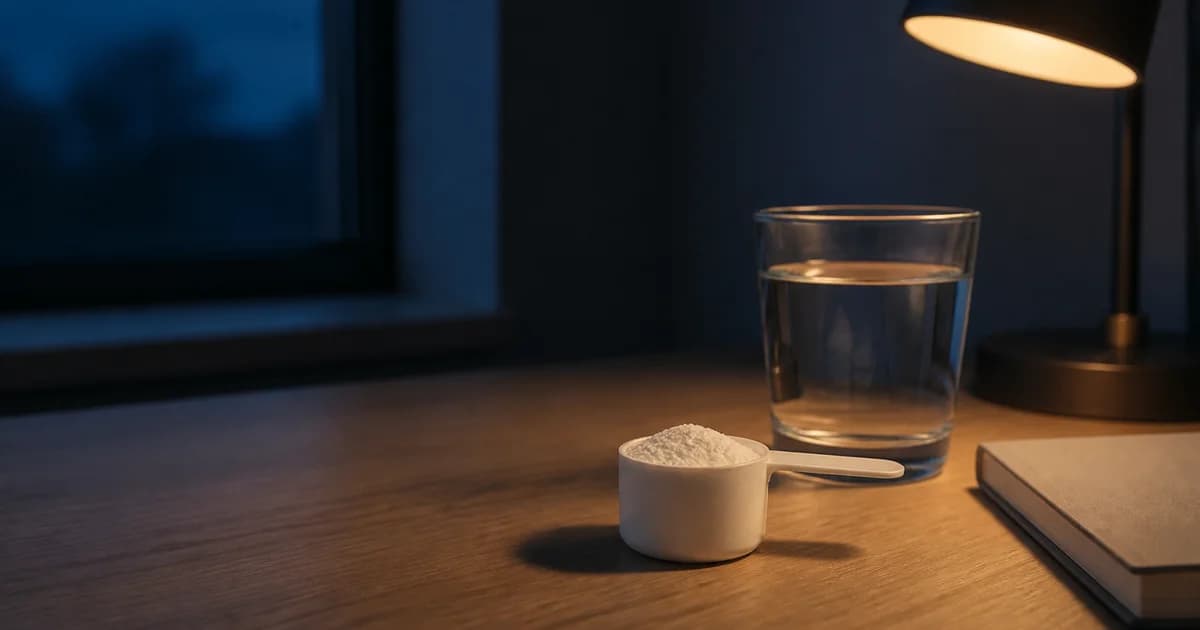
Creatine is usually discussed as a sports supplement. A newer question is whether it can help the brain cope when sleep is lost. Two small controlled experiments point to a possible short-term effect, but they tested a very specific situation: healthy adults kept awake for one night. They do not show that creatine is a general focus booster or that it makes missed sleep harmless. The broader adult evidence is still uncertain. [1][2][3]
What the first trial tested
The first experiment, published in 2024, used a double-blind, randomized crossover design. Fifteen healthy adults, aged 20 to 28 years, completed one session with creatine and another with placebo. On each study night they were kept awake for a subtotal of 21 hours. The creatine session used a single dose of 0.35 g/kg, given in the evening, followed by cognitive tests and brain scans at several points through the night. [1]
Compared with placebo, the creatine session produced better results in several language, logic, and numeric tasks, as well as faster processing in some tasks. The researchers also reported an 8 ± 7% reduction in fatigue at the later testing points when those points were pooled. Their conclusion was not that creatine erased sleep loss. It was that a single high dose partially reduced the cognitive and metabolic deterioration seen during the experiment, with the largest cognitive effect around 4 hours after dosing and an effect lasting up to 9 hours. [1]
The second trial used a lower dose
A follow-up study, published in 2026, asked whether a lower acute dose showed a similar pattern. It included 29 healthy adults aged 20 to 40 years, who completed creatine and placebo sessions during another total of 21 hours without sleep. The single dose was 0.2 g/kg. Cognitive tests were taken at baseline and 3, 5.5, and 7.5 hours after dosing. [2]
The lower-dose trial found less deterioration in logical and numerical tasks, language-related processing speed, and the Psychomotor Vigilance Test. The authors reported improvement of up to 12% in the measured outcomes, while also stating that the effect was less pronounced than in the earlier 0.35 g/kg experiment. The participant group was still small, young, healthy, and studied under tightly controlled laboratory conditions. [2]
Why the result is promising but narrow
The two experiments agree on a useful possibility: when the brain is under the acute stress of enforced wakefulness, extra creatine availability may help support performance on some demanding tasks. They also share important limits. Both were acute-dose studies, both used a single night of sleep deprivation, and both recruited healthy adults rather than people with insomnia, neurological disease, or other clinical conditions. Neither tested a normal workday after an ordinary poor night, repeated sleep restriction, or whether the supplement improves judgment well enough to make driving or other risky activities safe. Those questions remain open. [1][2]
The wider evidence does not turn the result into a settled claim. A 2024 systematic review and meta-analysis included 16 randomized trials with 492 participants aged 20.8 to 76.4 years. It found possible benefits in memory, attention time, and information-processing speed, but rated the evidence for several major cognitive outcomes as low certainty and called for larger, more robust trials. That mixed picture matters: the sleep-deprivation studies are interesting additions, not proof that everyone will think more clearly after taking creatine. [3]
The practical takeaway
- The strongest signal is specific to acute sleep deprivation, not everyday concentration. [1][2]
- The studied doses were experimental acute doses, not a personal recommendation or a routine schedule. [1][2]
- The most defensible conclusion is that creatine deserves more research in stressed and sleep-deprived populations, while sleep itself remains outside the scope of what these trials tested. [3]