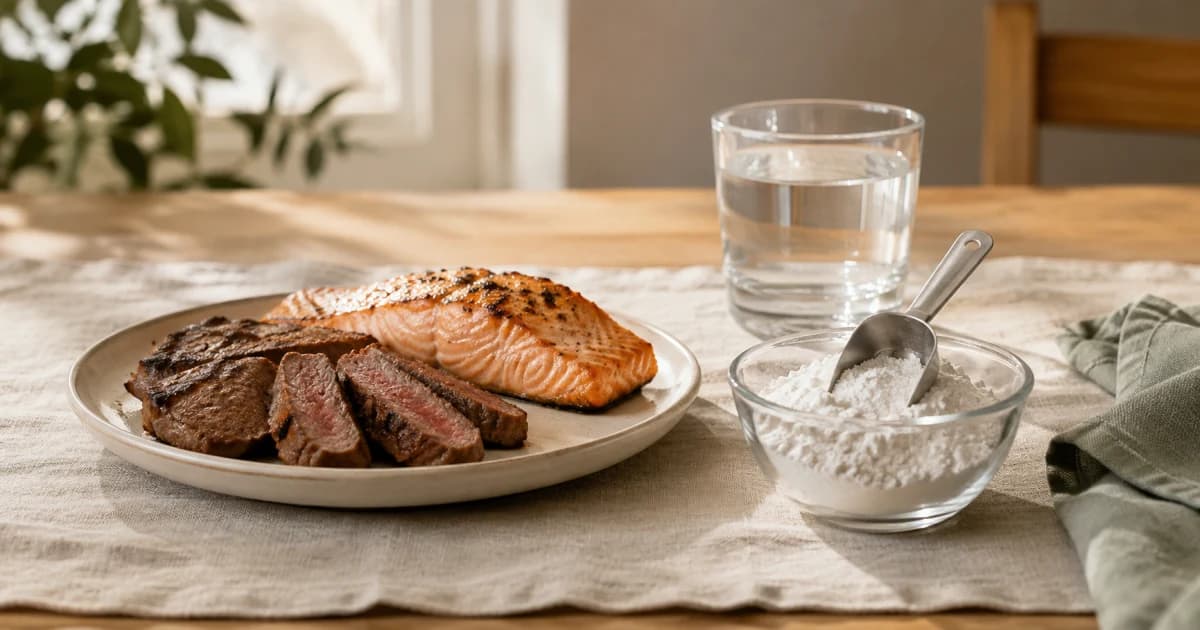
The creatine in a steak is real, but a normal meal does not turn into a scoop of powder. Meat and fish can supply creatine, yet the amount in an ordinary plate is modest. The question is not whether food contains it. It is whether food can deliver the concentrated amount that supplement studies often use. [1][2]
The short answer is: food can contribute, but supplements are much easier to measure and repeat. Your body also makes creatine on its own, at about 1 g per day according to the National Institutes of Health fact sheet. Creatine helps muscles produce quick energy, especially during repeated, hard bursts of activity. [1]
What food actually provides
Creatine is found mainly in animal muscle, so beef, pork and salmon are useful examples. The NIH fact sheet lists roughly 2 g per pound of beef, 2.3 g per pound of pork and 2 g per pound of salmon. Those are broad food estimates, not guaranteed values for every cut or plate. [1]
A food table in a U.S. Food and Drug Administration safety dossier shows the same kind of variation. Several raw pork muscles are listed at around 2.5–3.7 g per kilogram, while raw cod is listed at about 3.6 g per kilogram. The cut, its water content and the cooking method all change what remains in the food. [2]
Food creatine is not just a theory on a nutrition label. In a small 2002 absorption study, 5 people who did not use creatine supplements consumed 2 g of creatine in meat or in a drink. Both forms appeared in the blood, although the study measured absorption over 6 hours rather than strength or muscle growth. [3]
Why the powder looks stronger on paper
The common mistake is comparing a food by weight with a supplement by scoop. A serving of food brings protein, fat, water and calories along with its creatine. Plain creatine monohydrate isolates the compound, so the amount can be kept steady without building an entire meal around it. [1]
The difference becomes clearer in the research. The NIH fact sheet says performance effects generally appear when people consume much greater amounts over time from supplements. It describes studies using 20 g per day for 5–7 days followed by 3–5 g per day, or 3–6 g per day for 3–4 weeks. These are research plans for exercise, not a personal instruction for what anyone should take. [1]
Cooking adds another wrinkle. The FDA dossier lists different creatine values for raw and cooked foods, rather than one universal cooking-loss number. That is a good reason to treat food estimates as approximate and not to promise that a certain recipe replaces a measured supplement amount. [2]
The vegetarian question
People who eat little or no meat and fish get less dietary creatine, but their bodies still make it. A metabolism review explains that meat and fish are the main food sources, so people following vegetarian diets replace more of their daily creatine needs through internal production. [4]
A 2020 systematic review of 9 studies, reported across 11 articles, found that supplementation raised muscle creatine-related stores in vegetarian participants, often to levels higher than in omnivores. But the review found mixed evidence on whether their exercise performance improved more than that of omnivores, and it judged the included studies to have moderate-to-high risk of bias. [5]
What the choice actually changes
- Food gives creatine as part of a meal. That can be useful, but it is not a precise way to match the larger amounts used in supplement research. [1][2]
- Powder is more concentrated and repeatable. Creatine monohydrate is the most widely used and studied form, while costlier forms have not proved superior. [1]
- For a vegetarian or vegan diet, a supplement may raise muscle stores because the diet supplies little dietary creatine. That does not guarantee a larger performance benefit than an omnivore gets. [5][4]
- For training, the best-supported use is repeated short, high-intensity work such as lifting or sprinting, not every kind of exercise. [1]
How to read the choice without overthinking it
- If a product lists creatine monohydrate, it is using the form with the deepest research record. [1]
- If a claim depends on a special form, ask whether it has actually beaten monohydrate in studies. The NIH fact sheet says other forms have not shown better results for raising muscle creatine, digestion, stability or safety. [1]
- If food is already part of the diet, do not force extra meat just to chase a number. A varied meal has value beyond one compound, and food estimates are too variable to act like a measuring spoon. [2]
Here is where the question stands in 2026: food absolutely provides creatine, and the body makes it too. But if the goal is the consistent, concentrated amount used in exercise studies, food and powder are not interchangeable on a plate-for-scoop basis. The practical decision is less dramatic: keep food for what food does well, and judge a supplement by the evidence for its specific form and use. [1][2]